France has made high-performance cryogenics a strategic enabling technology within its National Quantum Strategy
Through CRYONEXT, research organisations, cryogenic specialists and quantum technology companies are developing the technologies required by future quantum systems.
Absolut System contributes to this effort by transforming cryogenic R&D into technological building blocks and, ultimately, integrated industrial solutions.
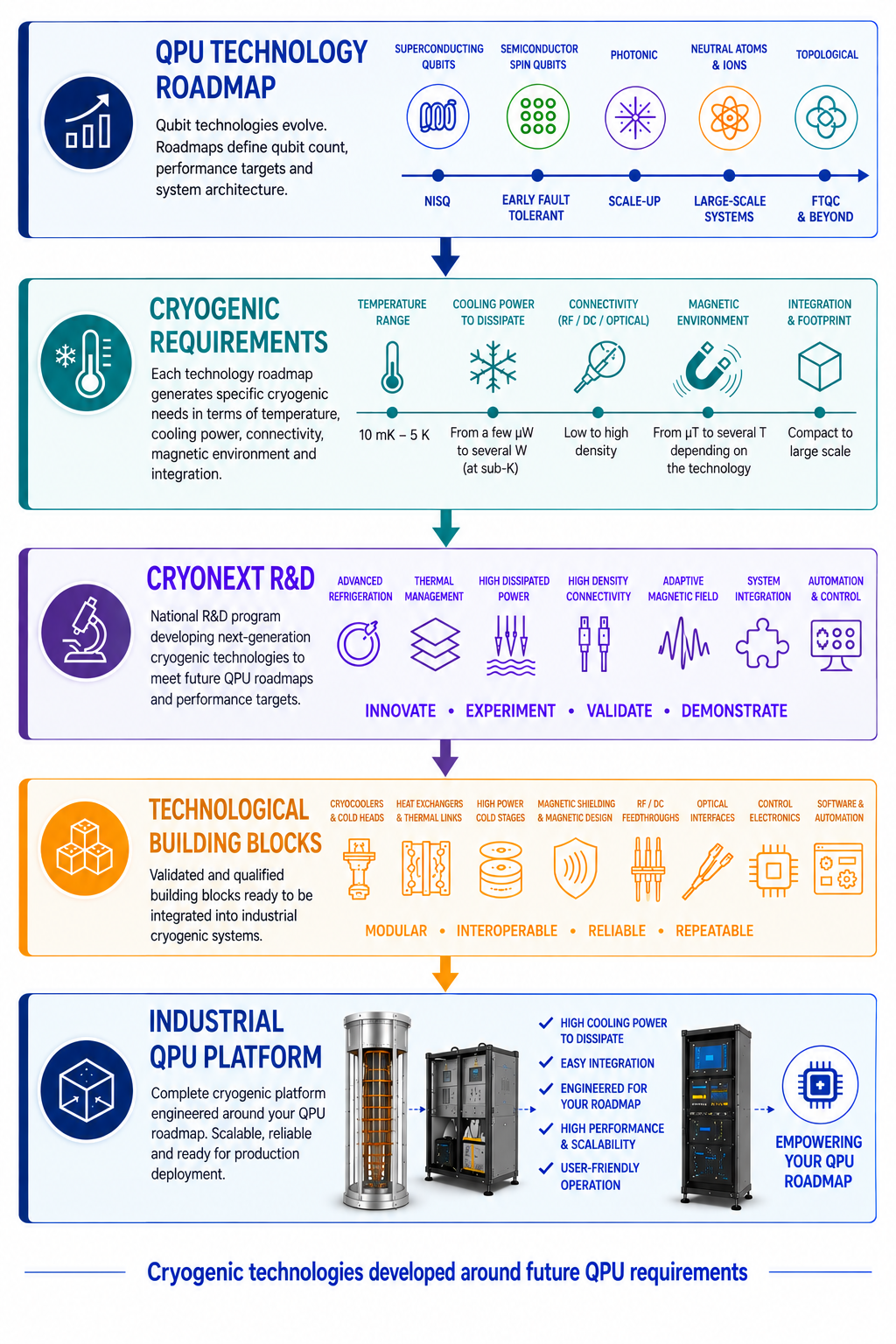


CRYONEXT is a major Research & Innovation programme supported by France 2030 as part of the
French National Strategy for Quantum Technologies.
Led by the CEA and CNRS, the programme benefits from up to €34 million in State funding over six
years and brings together research organisations, cryogenic specialists and quantum technology
companies to develop the next generation of high-performance cryogenic technologies.
The programme addresses a fundamental challenge for the quantum industry: anticipating future
cryogenic requirements before they become a constraint on the development and scale-up of
quantum technologies.
Different quantum technologies require very different cryogenic environments. Temperature alone is
not sufficient to define the solution. Cooling power, thermal loads, magnetic constraints, connectivity,
optical access, integration density, vibration, automation and system architecture must all be
considered together.
France is investing not only in quantum processors, but also in the critical technologies required to
operate and scale them.
This long-term investment in high-performance cryogenics contributes to building technological
sovereignty and a sustainable industrial ecosystem for quantum technologies in France and Europe.
Cryogenics must scale at the same pace as the quantum technology: this is the philosophy behind
Absolut System's involvement in CRYONEXT.


From laboratory cryogenics to mobile quantum systems
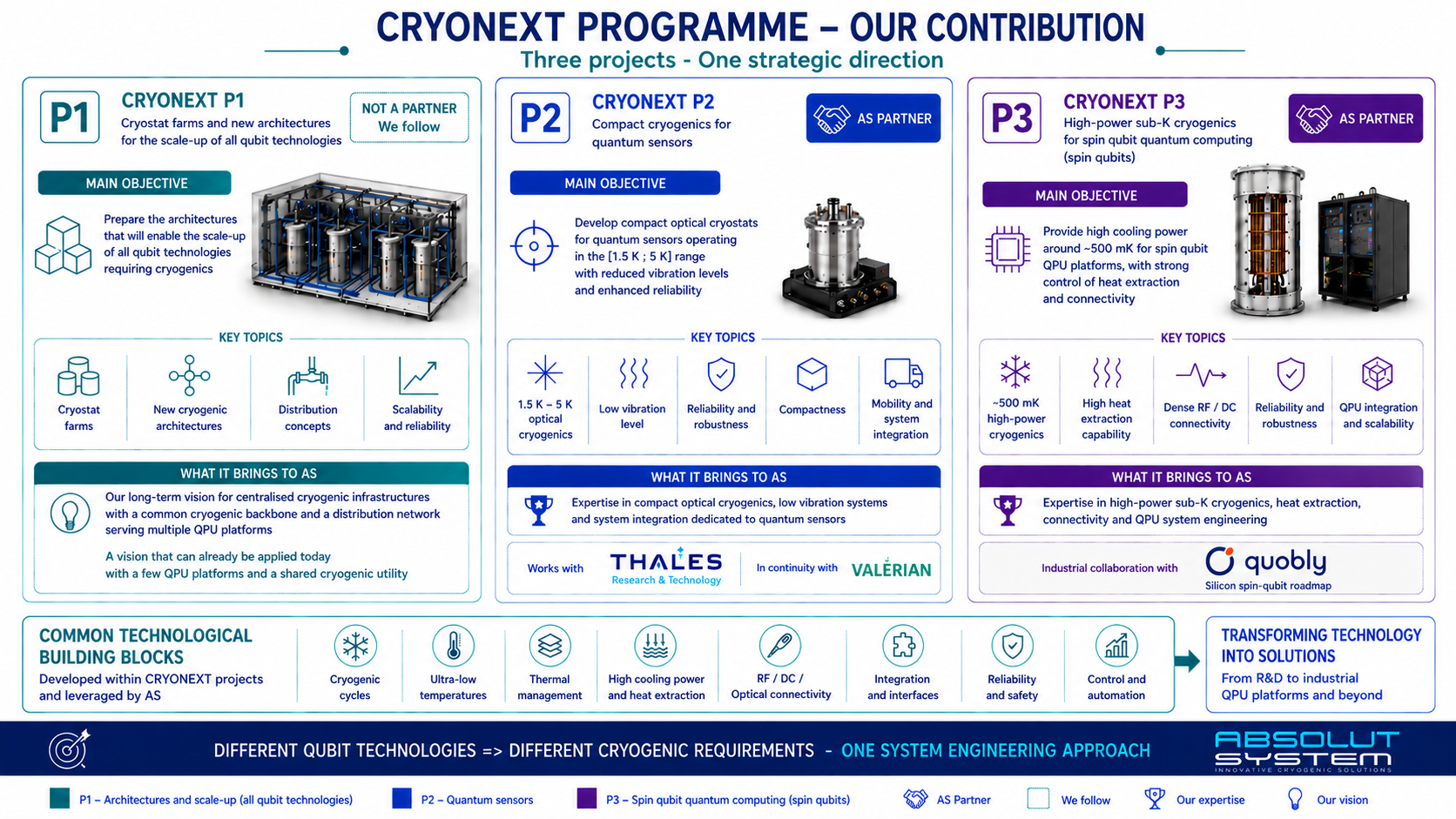
CRYONEXT P2 addresses the development of 1.5K – 5K cryogenic systems optimised for photonic applications, with particular attention to thermal performance, compactness and optical integration.
Within this project, Absolut System works with Thales Research & Technology on the development of
an optical cryostat targeting the future integration of quantum sensing technologies into mobile systems.
This work continues technological developments initiated through the VALERIAN programme, moving from laboratory-oriented cryogenic technologies towards increasingly integrated systems subject to demanding operational constraints.
The challenge is therefore not simply to reach the required temperature. The cryogenic system must combine:
Cooling performance • High heat dissipation capability • Optical integration • Compactness • Low
vibration • Reliability • Mobility • System integration
From laboratory demonstrators to integrated and mobile quantum sensing systems:
VALERIAN → CRYONEXT P2 → TECHNOLOGY BUILDING BLOCKS → MOBILE QUANTUM
SYSTEMS
For Absolut System, P2 contributes to developing expertise and technological building blocks that can subsequently be integrated into compact, robust and operational cryogenic systems.
CRYONEXT P3 focuses on the development of high-power cryogenic systems around 500 mK for semiconductor quantum technologies.
This temperature range is particularly relevant to silicon spin-qubit architectures and their future scale-up.
As semiconductor QPUs grow, the cryogenic challenge progressively shifts from achieving low temperature alone towards the ability to extract increasingly significant thermal loads while integrating a growing number of electrical and RF connections and maintaining the environment required by the QPU.
P3 therefore contributes to the development of technological capabilities in:
High cooling power • Sub-K thermal architecture • Heat extraction • RF & DC integration • Magnetic
environment • Mechanical integration • Instrumentation • Automation
The challenge is not simply to reach 500 mK — it is to provide the cooling power and system architecture required by future semiconductor QPUs
For Absolut System, technological development only creates value for the quantum industry when it can ultimately be transformed into reliable, manufacturable and scalable systems.
The expertise and technological developments associated with high-power sub-Kelvin cryogenics are now supporting Absolut System’s industrial roadmap for semiconductor quantum computing.
This approach is materialising through our cooperation with Quobly and the development of a dedicated QPU Integration Platform engineered around its silicon spin-qubit roadmap.
This cooperation illustrates Absolut System’s ambition to move from cryogenic technology development towards complete industrial platforms designed around the requirements of QPU manufacturers.
Absolut System is not a partner in P1 but closely follows its developments, as they are directly aligned
with our long-term vision for shared cryogenic infrastructure serving multiple QPU Integration
Platforms.
One cold-generation infrastructure, Multiple QPU platforms!
Whatever the future architecture, cooling must ultimately be generated, transferred and distributed to the QPU platforms.
This creates a new engineering challenge. Instead of considering the cryostat as an isolated piece of equipment, future large-scale quantum infrastructures may combine: Centralised cold generation + Cryogenic distribution network + Multiple QPU Integration Platforms + Dedicated control & readout electronics for each QPU
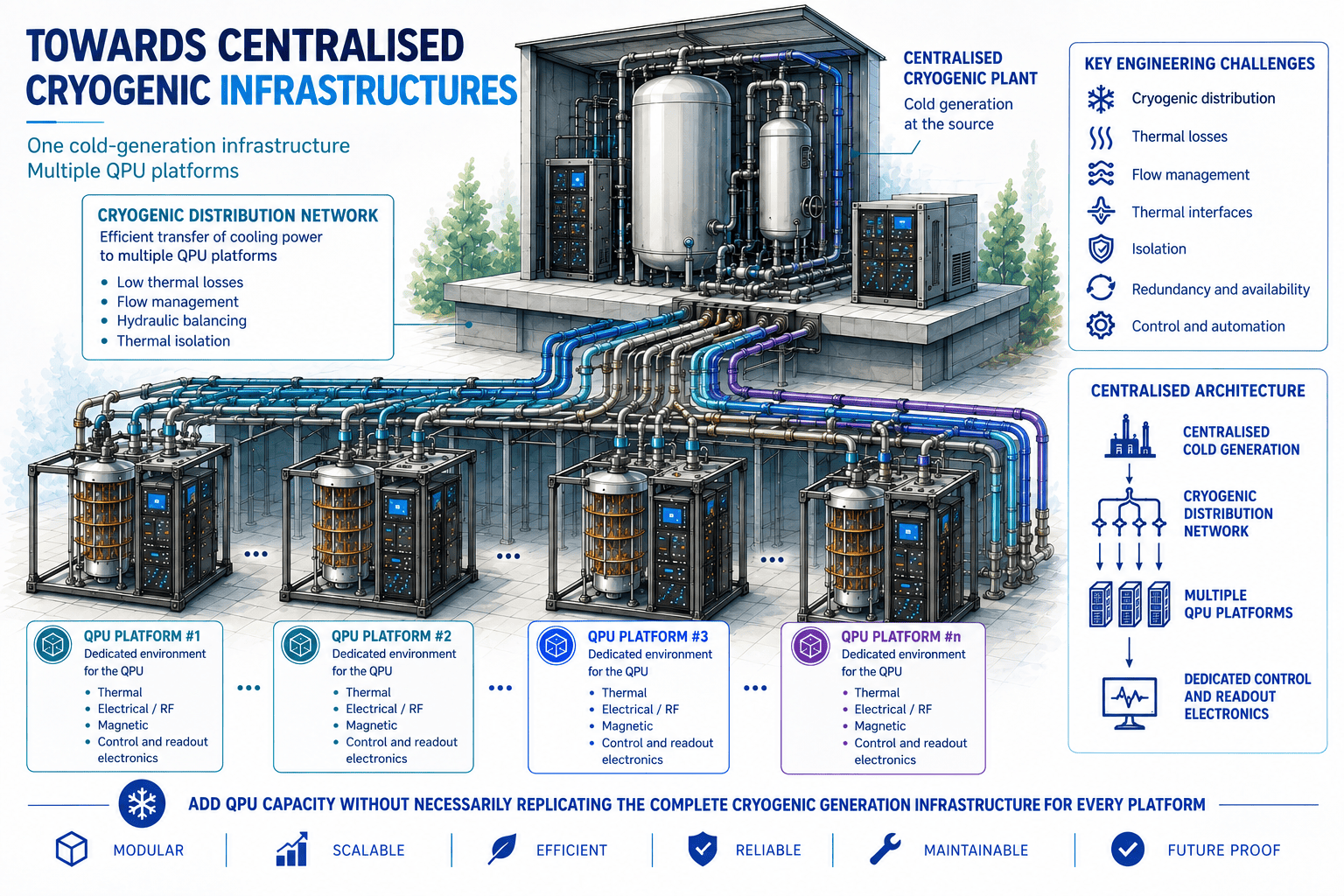
The primary cold-generation infrastructure can progressively become a shared utility, while each QPU Integration Platform retains the thermal, electrical, RF, magnetic and mechanical environment required by its processor.
This transition introduces major engineering challenges:
Cryogenic distribution • Thermal losses • Flow management • Hydraulic balancing • Thermal
interfaces • Isolation • Redundancy • Availability • Maintainability • Control & automation
This is where cryogenic system engineering becomes critical. The ability to generate cooling power is only one part of the challenge.
The ability to transport and distribute that cooling power efficiently, reliably and at the required temperature to multiple QPU platforms will become a key enabling technology for future large quantum infrastructures.
This is an area where Absolut System's expertise in cryogenic engineering, thermal management, fluid distribution and complete system architecture can play a major role.
CRYONEXT gives France a framework for developing the cryogenic technologies required by future
quantum systems.
Absolut System’s role is to help transform these technologies into industrial cryogenic solutions engineered around real quantum-system roadmaps.
This end-to-end capability allows us to combine individual technological building blocks into complete cryogenic systems adapted to each application.
We don’t just design cryostats, We engineer the cryogenic infrastructure around your quantum technology roadmap
Building sovereign cryogenic technologies for the French quantum ecosystem. CRYONEXT is a major Research & Innovation programme supported by France 2030 as part of the French National Strategy for Quantum Technologies.
Led by the CEA and CNRS, the programme benefits from up to €34 million in State funding over six years and brings together research organisations, cryogenic specialists and quantum technology companies to develop the next generation of high-performance cryogenic technologies.
The programme addresses a fundamental challenge for the quantum industry: anticipating future cryogenic requirements before they become a constraint on the development and scale-up of quantum technologies.
Different quantum technologies require very different cryogenic environments. Temperature alone is not sufficient to define the solution. Cooling power, thermal loads, magnetic constraints, connectivity, optical access, integration density, vibration, automation and system architecture must all be considered together.
France is investing not only in quantum processors, but also in the critical technologies required to operate and scale them.
This long-term investment in high-performance cryogenics contributes to building technological sovereignty and a sustainable industrial ecosystem for quantum technologies in France and Europe.
Cryogenics must scale at the same pace as the quantum technology: this is the philosophy behind Absolut System’s involvement in CRYONEXT.
From laboratory cryogenics to mobile quantum systems. CRYONEXT P2 addresses the development of 1.5K – 5K cryogenic systems optimised for photonic applications, with particular attention to thermal performance, compactness and optical integration.
Within this project, Absolut System works with Thales Research & Technology on the development of an optical cryostat targeting the future integration of quantum sensing technologies into mobile systems.
This work continues technological developments initiated through the VALERIAN programme, moving from laboratory-oriented cryogenic technologies towards increasingly integrated systems subject to demanding operational constraints.
The challenge is therefore not simply to reach the required temperature. The cryogenic system must combine: Cooling performance • High heat dissipation capability • Optical integration • Compactness • Low vibration • Reliability • Mobility • System integration.
From laboratory demonstrators to integrated and mobile quantum sensing systems: VALERIAN → CRYONEXT P2 → TECHNOLOGY BUILDING BLOCKS → MOBILE QUANTUM SYSTEMS.
For Absolut System, P2 contributes to developing expertise and technological building blocks that can subsequently be integrated into compact, robust and operational cryogenic systems.
Cryogenic technologies for photonics and quantum sensing
Preparing cryogenics for semiconductor QPU scale-up. CRYONEXT P3 focuses on the development of high-power cryogenic systems around 500 mK for semiconductor quantum technologies.
This temperature range is particularly relevant to silicon spin-qubit architectures and their future scale-up.
As semiconductor QPUs grow, the cryogenic challenge progressively shifts from achieving low temperature alone towards the ability to extract increasingly significant thermal loads while integrating a growing number of electrical and RF connections and maintaining the environment required by the QPU.
P3 therefore contributes to the development of technological capabilities in: High cooling power • Sub-K thermal architecture • Heat extraction • RF & DC integration • Magnetic environment • Mechanical integration • Instrumentation • Automation.
The challenge is not simply to reach 500 mK — it is to provide the cooling power and system architecture required by future semiconductor QPUs.
For Absolut System, technological development only creates value for the quantum industry when it can ultimately be transformed into reliable, manufacturable and scalable systems.
The expertise and technological developments associated with high-power sub-Kelvin cryogenics are now supporting Absolut System’s industrial roadmap for semiconductor quantum computing.
This approach is materialising through our cooperation with Quobly and the development of a dedicated QPU Integration Platform engineered around its silicon spin-qubit roadmap.
This cooperation illustrates Absolut System’s ambition to move from cryogenic technology development towards complete industrial platforms designed around the requirements of QPU manufacturers.
From individual cryostats to multi-QPU cryogenic infrastructures
CRYONEXT P1 explores cryostat farms and new cryogenic architectures for quantum scale-up.
Absolut System is not a partner in P1 but closely follows its developments, as they are directly aligned with our long-term vision for shared cryogenic infrastructure serving multiple QPU Integration Platforms.
