Quobly and Absolut System celebrate a major milestone in their cooperation with the completion of the Preliminary Design Review (PDR) of Qcube(r) 100-Class 3, the new high-power cryogenic platform ordered by Quobly to support the development of its spin-qubit quantum processors. This milestone confirms the structural choices made in the platform’s architecture and now paves the way for its realization, integration and qualification.
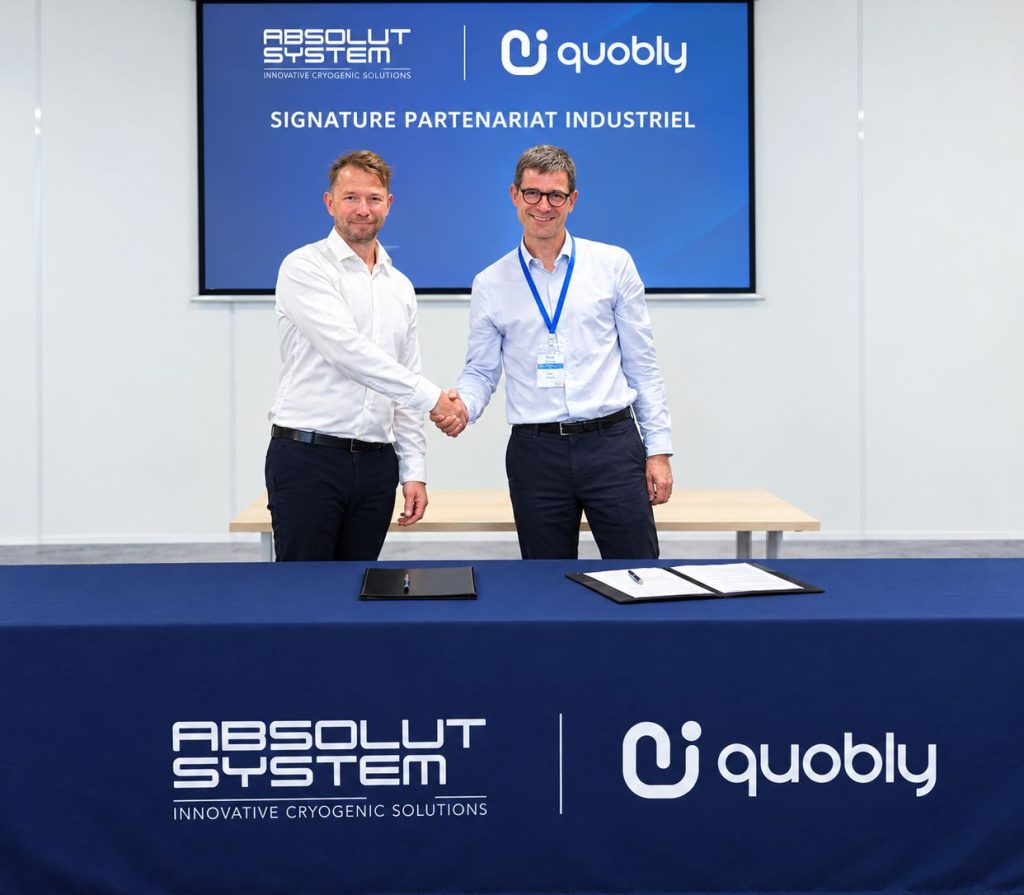
On this occasion, the two companies take a further step by signing an industrial partnership declaration that reaffirms their commitment to place this first achievement within a shared, long-term trajectory, in line with the framework agreement already established between the two companies.
This roadmap is designed to progressively support Quobly, from the first development platforms to the future cryogenic infrastructures required for the volume production of systems capable of supporting 100,000 physical spin qubits, or even beyond, on the path toward fault-tolerant quantum computing (Fault-Tolerant Quantum Computing – FTQC).
With Qcube(r) 100-Class 3, Absolut System is developing a new generation of cryogenic platforms designed to meet the growing cooling power needs of semiconductor-based quantum architectures. The platform targets a cooling capacity of 100 mW at 500 mK and integrates the thermal, mechanical, electrical and RF interfaces, as well as the control functions required for the integration and operation of Quobly’s QPUs (quantum chips).
This cooperation reflects a shared conviction: quantum scale-up requires the QPU and its cryogenic infrastructure to evolve together.
The growing number of qubits, the densification of interconnects, the progressive integration of low-temperature control electronics, and increasing thermal loads will require cryogenic architectures that are increasingly powerful, integrated, modular, reliable and industrializable.
The cooperation between Quobly and Absolut System is thus part of a progressive trajectory across four phases:
This trajectory is aligned with Quobly’s Alloy quantum computer roadmap, with a first generation of systems targeting up to 100,000 physical qubits between 2027 and 2029, followed by further scaling milestones from 2030 onward, on the path toward systems ultimately capable of reaching one million qubits and fault-tolerant quantum computing.
For Absolut System, this approach reflects the ambition to move beyond the traditional role of cryostat supplier to become a genuine Cryogenic System Engineering Partner for QPU manufacturers: understanding their technology roadmap, anticipating the associated cryogenic needs, and developing together with them the architectures that enable their scale-up.
Cryogenics is an enabling technology essential to the operation of most quantum processors. The challenge is now different: making sure it does not become a limiting factor as QPUs scale up.
Cooling power, interconnect density, thermal distribution, RF integration, vacuum, automation, maintainability and energy efficiency will all need to evolve at the pace of successive generations of processors.
This ambition is what shapes the QCube® range, conceived not as a simple family of cryostats but as QPU Integration Platforms that are industrial, customizable, robust and scalable.
Absolut System’s objective is to progressively make the cryogenic infrastructure simple to operate, reliable and as transparent as possible for its users. QPU manufacturers should be able to use cryogenics as an industrial infrastructure serving their processor, without having to maintain in-house expertise in this technology over the long term.
This approach draws on the expertise developed by Absolut System since 2010 in complete cryogenic systems, Pulse Tube and Joule-Thomson technologies, heat exchangers, vacuum, control systems, and cooling architectures tailored to its customers’ specific needs.
Beyond this first platform, Quobly and Absolut System aim to jointly anticipate the architectural breakthroughs that the shift from today’s processors to future large-scale quantum systems will require.
The hybridization of High Performance Computing (HPC) and Quantum Computing is already underway in Europe. EuroHPC is currently developing a network of quantum computers based on different qubit technologies, integrated into its European supercomputing infrastructure. The MeluXina-Q project illustrates the growing interest in semiconductor spin-qubit processors within this type of environment.
In this perspective, cryogenics will also need to scale up: increasing available cooling power, densifying interconnects, modularity, automation, energy efficiency, simplified maintenance and, in the longer term, developing cryogenic infrastructures capable of supporting multiple QPU modules.
Qcube(r) 100-Class 3 is the first concrete building block of this shared trajectory.
This cooperation takes on particular significance in Grenoble, where leading expertise is concentrated in semiconductors, CMOS technologies, cryogenics and quantum technologies.
The presence of Quobly and Absolut System, combined with a scientific and technological environment that notably includes CEA and the Néel Institute (CNRS), helps bring together the expertise needed to turn research breakthroughs into industrializable quantum technologies. These two major research centers are also involved alongside Absolut System and Quobly as part of the CRYONEXT R&D program, which is part of the national quantum strategy and contributes to the development of the QCube® product line.
The FTQC challenge cannot indeed be met by a single, isolated player. It will require QPU manufacturers, semiconductor specialists, cryogenicists, electronics engineers, laboratories, integrators and HPC players.
Through their partnership, Quobly and Absolut System intend to contribute to this momentum and jointly prepare the technological and industrial building blocks required for future generations of spin-qubit quantum computers.
